
martes, 15 de diciembre de 2020


EHang | EHang 216 Receives Long-term Trial Flight Permit across Austria National Airspace


(Guangzhou, China, December 14, 2020) EHang Holdings Limited (Nasdaq: EH) ("EHang" or the "Company"), the world's leading autonomous aerial vehicle ("AAV") technology platform company achieved a significant milestone on the path to offering Urban Air Mobility ("UAM") services worldwide. On December 9, the Civil Aviation Authority of Austria issued a trial flight permit for the EH216 passenger-grade AAV. The permit allows trial operation of full unmanned flights in Austrian national airspace. This is the first flight permit for EHang's passenger-grade AAVs within the European Union.
Through the joint efforts of the Civil Aviation Authority of Austria, the EHang European team, and local partners, the Company has achieved another important regulatory breakthrough in the geographical heart of Europe, enabling more people to experience its safe, green and comfortable UAM solutions. This achievement should enable EHang to accelerate commercial operations in Europe. The trial permit and flight operations will support EHang's growth in the European Market by demonstrating the benefits of its UAM solutions to regulators, customers, and partners.
Autonomous Aerial Vehicles are poised to change the way people and cargo move from point A to point B. Whether for commuting within a large city or traveling from rural to metropolitan areas, aerial travel will dramatically change how mankind perceives distance and travel time. What is a reality today in Asia also comes closer in Europe.
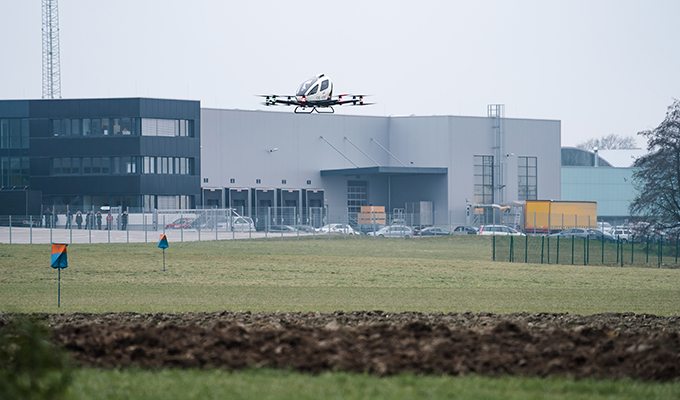
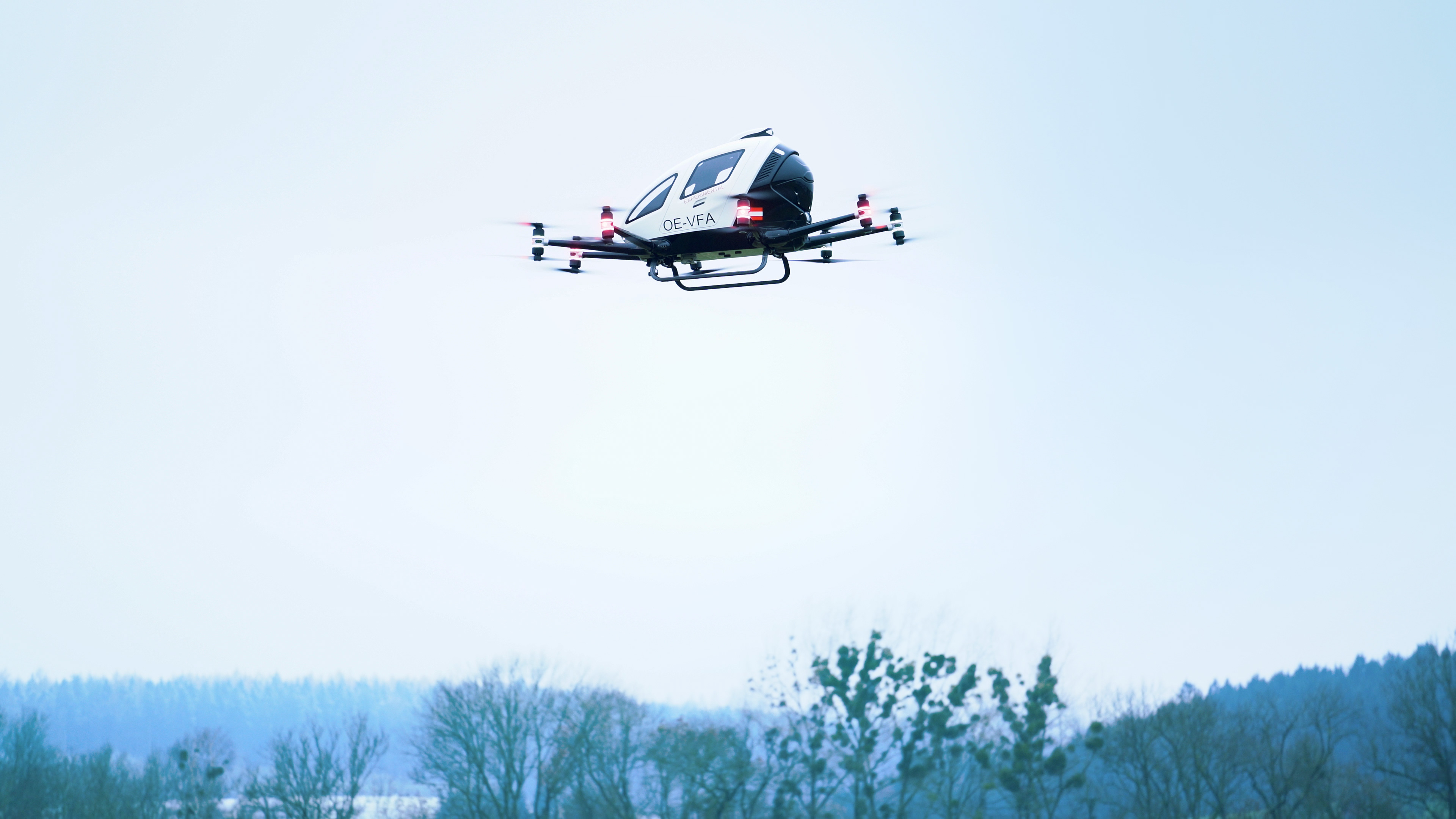
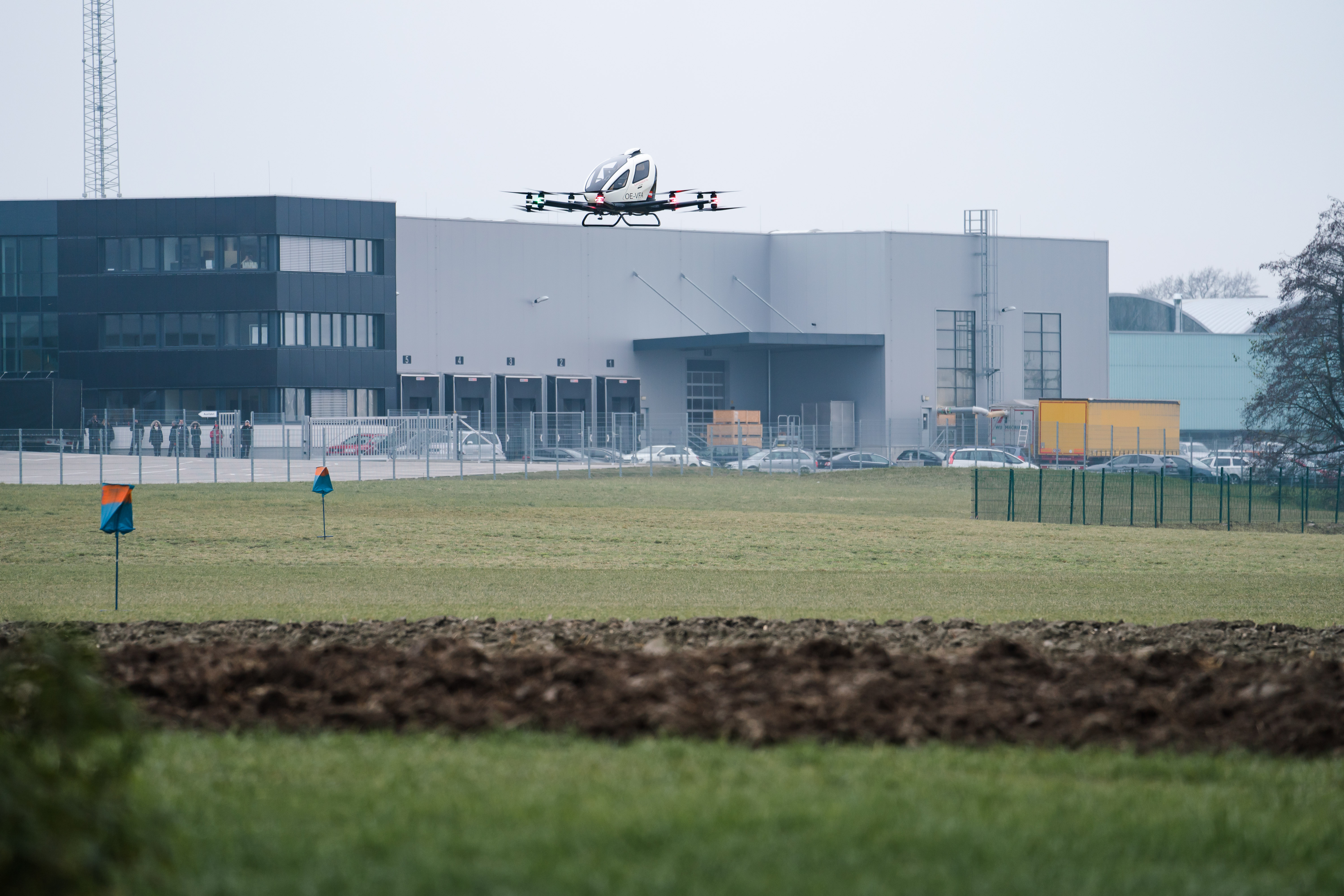
As part of the process, a test flight occurred in November 2020. It was the first flight ever in open EASA airspace. After a Specific Operational Risk Assessment (SORA) procedure, an EH216 AAV with the registration number OE-VFA took off in St. Martin im Innkreis, in the province of Upper Austria. Under the supervision of the Civil Aviation Authority, the unmanned aircraft took off for several minutes via automatic flight programming and then safely landed, despite harsh weather conditions of severe cold and high wind speed.
The permit was obtained together with EHang's strategic partner FACC AG. Technical experts from both companies worked for several months with the national regulators to meet the national and European requirements.
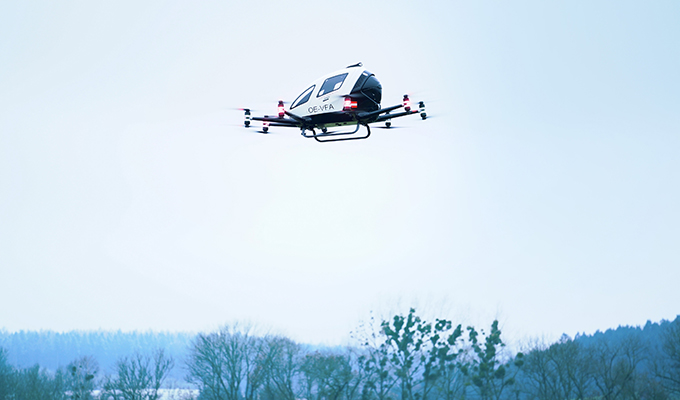
The EH216 first flight took place in November 2020 in St. Martin im Innkreis, Upper Austria.
About EHang
EHang (Nasdaq: EH) is the world's leading autonomous aerial vehicle (AAV) technology platform company. Our mission is to make safe, autonomous, and eco-friendly air mobility accessible to everyone. EHang provides customers in various industries with AAV products and commercial solutions: air mobility (including passenger transportation and logistics), smart city management, and aerial media solutions. As the forerunner of cutting-edge AAV technologies and commercial solutions in the global Urban Air Mobility (UAM) industry, EHang continues to explore the boundaries of the sky to make flying technologies benefit our life in smart cities. For more information, please visit www.ehang.com.
Safe Harbor Statement
This press release contains statements that may constitute "forward-looking" statements pursuant to the "safe harbor" provisions of the U.S. Private Securities Litigation Reform Act of 1995. These forward-looking statements can be identified by terminology such as "will," "expects," "anticipates," "aims," "future," "intends," "plans," "believes," "estimates," "likely to" and similar statements. Management has based these forward-looking statements on its current expectations, assumptions, estimates and projections. While they believe these expectations, assumptions, estimates and projections are reasonable, such forward-looking statements are only predictions and involve known and unknown risks and uncertainties, many of which are beyond management's control. These statements involve risks and uncertainties that may cause EHang's actual results, performance or achievements to differ materially from any future results, performance or achievements expressed or implied by these forward-looking statements.
LiquidPiston's "inside-out" rotary X-Engine wins Army research contract
Beyond Tube-and-Wing | free book by NASA
Flying Forward 2020 officially launches - Urban Air Mobility News


lunes, 14 de diciembre de 2020
Trustworthy artificial intelligence: Rolls-Royce publishes pioneering bias-control AI ethics toolkit
press release
Rolls-Royce has released its breakthrough work on artificial intelligence (AI) ethics and trustworthiness to help support the future health, wealth and growth of the world.
The comprehensive ethical framework and trustworthiness process is free to download from the Rolls-Royce website. Once fully implemented, businesses that follow the checks and balances within it can assure themselves that their AI projects are fair, trustworthy and ethical.
We have called this toolkit The Aletheia FrameworkTM, after the Greek goddess of trust and disclosure, and believe it will help address one of the biggest barriers to the widespread use of AI – mistrust.
Warren East, Chief Executive Officer, Rolls-Royce, who announced the breakthrough in September, said: “I hope today’s publication will become a watershed moment for artificial intelligence. As we move rapidly to a more digital world, people have a right to expect that AI is used ethically and that it is a trustworthy partner for people and society.
“The Aletheia FrameworkTM provides the foundations for that to happen, so business leaders, academics, technologists and even philosophers can now move from simply talking about the potential of AI, to unlocking its benefits for the health, wealth and growth of the world.
“It’s with that objective in mind that Rolls-Royce has decided we need to make this free for anyone to access and we will seek to build partnerships with interested organisations to support its widespread application, so that we can all build trust in AI.”
The Aletheia Framework™ is a checklist that invites organisations to consider the impacts of using artificial intelligence prior to deciding whether to proceed. It looks across a total of 32 facets of societal impact, governance and trust, and transparency and requires executives and boards to provide evidence that these have been rigorously considered.
Once the AI has been applied, the framework includes a five-step continuous automated checking process, which, if comprehensively applied, tracks the decisions the AI is making to detect bias or malfunction and allow human intervention to control and correct it.
Caroline Gorski, Group Director of R2 Data Labs, the data innovation team for Rolls-Royce, said: “Rolls-Royce is a global industrial technology leader and has used artificial intelligence for decades to analyse more than 70 trillion data points across 26 dimensions on our jet engines so we can increase the amount of time they fly and improve their sustainability.
“We’re now developing AI for quality inspections of critical components and it’s in the justification of applying artificial intelligence technologies to this activity that we have had to challenge ourselves to ensure it’s the right thing to do, and that it’s trustworthy.
“It’s that deep safety culture at the heart of our business that has created the mindset to apply safety principles to data. We can’t wait to share The Aletheia FrameworkTM with everyone and collaborate on the benefits to our world that we believe it will bring.”
With a potentially significant contribution to make in the global conversation on AI, The Aletheia FrameworkTM has been shared with experts from UNESCO, which is undertaking a global consultation on AI ethics.
Gabriela Ramos, Assistant Director-General for the Social and Human Sciences sector at UNESCO said: “In an initial exchange, The Aletheia FrameworkTM has been shared with UNESCO, which has been working with experts from around the world to develop recommendations for human-centred AI.”
“AI will radically change our world, but it is ethics that will shape how it looks. All stakeholders, whether public or private, must work on this together.”
The Aletheia FrameworkTM has been extensively reviewed and it was during that process its potential was revealed.
Lee Glazier, Head of Service Integrity, Rolls-Royce, who led the assurance work around the use of data and built the framework, said: “During the peer review process of our work with experts in big tech, healthcare, pharmaceuticals, academia and government, it became clear that no other organisation had progressed as far as we had. It was also clear that the applications for what is now The Aletheia FrameworkTM went beyond our own area of industrial use and into consumer applications, healthcare, recruitment, security – basically any use of artificial intelligence.”
The open-access publication of The Aletheia FrameworkTM is also intended to invite critique and collaboration from the global AI community to seek improvements. The decision to publish it follows a recent breakthrough in speech software for people living with motor-neurone disease (MND), motivated by a Rolls-Royce colleague who had personal experience with the disease.
The software improves the quality of life of people living with MND who cannot speak, by using AI to learn their voice, idioms, emotional inflections and phrases, so they can interact quickly with those around them. The experience of developing this software was among the AI activities that fed into the development of The Aletheia FrameworkTM.