http://www.abcdesevilla.es/20100220/sevilla-economia-empresas/clientes-a400m-plantan-oferta-20100220.html
Un portavoz del Ministerio alemán de Defensa informó ayer de que los siete países -Alemania, Francia, España, Reino Unido, Turquía, Bélgica y Luxemburgo- han presentado su última oferta. «Rechazamos cualquier renegociación sobre aspectos económicos, así como nuevas propuestas sobre cambios de carácter tecnológico», subrayó la citada fuente según informa Reuters.

sábado, 20 de febrero de 2010


EADS: USAF can buy 118 A400Ms with savings from C-130, C-5 retirements
http://www.flightglobal.com/articles/2010/02/19/338623/eads-usaf-can-buy-118-a400ms-with-savings-from-c-130-c-5.html
EADS North America has offered a plan for the US Air Force to purchase 118 Airbus A400Ms using savings from retiring most Lockheed Martin C-130Hs and all C-5As.
Korea Releases RFP For UCAV Demonstrator

South Korea's technologically ambitious defense ministry aims to test a scaled demonstrator for a stealthy combat drone by 2013, extending the country's expertise in unmanned aircraft and hedging against cancellation of the KF-X fighter program.
With this project, South Korea will be within 10 years of Britain and Germany in flying substantial development hardware for unmanned combat aircraft. South Korea may be ahead of Japan, which has announced no such development effort.
Jose M.
--
www.sandglasspatrol.com
www.noticias-aero.info
www.rbf.com.es
«El futuro pertenece a quienes creen en la belleza de sus sueños.»Eleanor Roosevelt (1884-1962)
viernes, 19 de febrero de 2010
New VXX competition reveals changes for US presidential helicopter
The US Navy has launched the process to buy a new presidential helicopter, nine months after deciding to cancel the Lockheed Martin/AgustaWestland VH-71 despite spending $3.2 billion
[...]
Rather than buy a common aircraft to replace 11 Sikorsky VH-3Ds and eight Sikorsky VH-60s, the service would consider splitting the contract with a mixed fleet, the RFI says. Options under review include buying a common aircraft with two variants, or simply purchasing two different aircraft types.
Foto: Japoneses y Estadounidenses volando sobre Guam / Photo: Japaneese and North American planes over Guam

Un B-52, seguido de dos F-16, dos F-2, dos EA6B Prowler y un E2CHawkeye sobre Guam.
Original Text:
A U.S. Air Force B-52 Stratofortress leads a formation of two F-16 Fighting Falcons, two Japan Air Self-Defense Force F-2 attack fighters, two U.S. Navy EA-6B Prowlers and an E-2C Hawkeye over Guam during Exercise Cope North, Feb. 15, 2010. U.S. Air Force photo by Staff Sgt. Jacob N. Bailey
Commercial Spaceflight Federation Welcomes Historic NASA Commitment
$75 Million Pledged For Commercial Suborbital Flights, Payloads
The Commercial Spaceflight Federation enthusiastically welcomed NASA's announcement Thursday that the agency will fund dozens of science and education payloads to fly on commercial suborbital vehicles built by companies including Armadillo Aerospace, Blue Origin, Masten Space Systems, Virgin Galactic, and XCOR Aerospace. At the first annual Next-Generation Suborbital Researchers Conference, NASA Deputy Administrator Lori Garver announced in her keynote speech today that President Obama's Fiscal Year 2011 budget request for NASA commits $75 million in funding over five years for the new Commercial Reusable Suborbital Research program (CRuSR).
Bye Energy, Inc. Launches The Green Flight Project
DENVER,Colorado– February18, 2010 – Bye Energy, Inc., an integrator of alternative energy and renewable fuel technologies for business and general aviation aircraft, is launching "The Green Flight Project" (www.TheGreenFlightProject.aero) to enhance the development of an electric and electric-hybrid propulsion system (EHPS) forcommercial application. The objective of the project is to design and integrate an EHPS into a full-scale proof of concept airplane.
System architecture for Bye Energy's EHPS includes an electric motor and controller, lithium-ion battery and management system, electric energy management system, auxiliarypower unit, thin film photovoltaic cells, variable pitch propeller and proprietary energy capture devices exclusive to the company.
George Bye, CEO of Bye Energy, said that although all-electric propulsion systems and aircraft are being developed, they do not yet compare to the potential utility and performance of a hybrid design. "Intelligent power management technology, greater lithium-ion energy density and more efficient light-weight engines have now matured to the point where integration of these components becomes extremely compelling," he said. "We believe the general aviation market is at the same point the U.S. auto market was about a decade ago when the first affordable automotive hybrid alternatives became commercially available."
Charlie Johnson, COO of Bye Energy and former President of Cessna, said the time to accelerate incorporation of new hybrid technology has arrived. "General aviation is a vital market that will benefit from the environmentally friendly, lower cost,more efficient and higher-performing aircraft," he said.
Over the past year, Bye Energy has forged relationships with multiple technical partners including UQM Technologies, Inc. (www.UQM.com) for the electric motor and controller, Vertical Power, Inc. (www.VerticalPower.com) for the energy management system, Porous Power Technologies, LLC (www.PorousPower.com) for the lithium-ion battery and separator technology, Scion Aviation, LLC (www.ScionAviation.com) for composite parts and materials, EEtrex Inc. (www.EEtrex.com) for the battery system and Ascent Solar Technologies, Inc. (www.AscentSolar.com) for thin film photovoltaics.
Bye Energy is accepting support from sponsors for The Green Flight Project. Early sponsors supporting the project launch include Wings over the Rockies Air & Space Museum and Colorado Capital Bank.
AboutBye Energy
Formed in 2008, Bye Energy is developing an electric and electric-hybrid propulsion system for light general aviation aircraft. The company is headquartered in the Denver Tech Center in Greenwood Village, Colo.,and also has offices in Scottsdale, Ariz., and Albuquerque, N.M. For more information, go to www.ByeEnergy.com. For photos or more information about The Green Flight Project, go to www.TheGreenFlightProject.aero
El avión militar de entrenamiento Yak-130 inicia las últimas fases de pruebas

"El nuevo Yak-130 fue ensamblado en la planta 'Sokol' de Nizhni Nóvgorod y hoy aterrizó en el aeródromo del Centro de Ensayos de Vuelo en Lípetsk, situado a 440 kilómetros al suroeste de Moscú, para iniciar las últimas fases de pruebas"
La Fundación AENA recupera en dos libros los artículos inéditos y conferencias del investigador de la aeronáutica Emilio Herrera
http://www.aerotendencias.com/cultura-aviacion/894-la-fundacion-aena-recupera-en-dos-libros-los-articulos-ineditos-y-conferencias-del-investigador-de-la-aeronautica-emilio-herrera
Jose M.
--
www.sandglasspatrol.com
www.noticias-aero.info
www.rbf.com.es
«El futuro pertenece a quienes creen en la belleza de sus sueños.»Eleanor Roosevelt (1884-1962)
Jose M.
--
www.sandglasspatrol.com
www.noticias-aero.info
www.rbf.com.es
«El futuro pertenece a quienes creen en la belleza de sus sueños.»Eleanor Roosevelt (1884-1962)
jueves, 18 de febrero de 2010
Seymourpowell introduces the Aircruise - a clipper in the clouds
Leading design and innovation company Seymourpowell is today unveiling full details of its visionary transportation concept, Aircruise - a giant, vertical airship powered by natural energy and designed to carry travellers in style and luxury.
Originally a self-generated project, Seymourpowell's Aircruise is the concept design for a hotel in the sky, with low passenger numbers and huge internal spaces offering room for living, dining and relaxing, as well as scope for dramatic and inspirational public spaces. The initial design proposes a bar/lounge zone, four duplex apartments, a penthouse and five smaller apartments.
The concept subsequently captured the imagination of Korean giant Samsung Construction and Trading (C&T). Driven by its interest in new materials for building, Samsung C&T appointed Seymourpowell to refine the idea and produce a detailed computer animation of the proposed experience to illustrate this visionary approach to the future. The video can be viewed here:
Seymourpowell's Aircruise concept presents an alternative take on the future, suggesting 'slow is the new fast'. Nick Talbot, design director at Seymourpowell explains, "The Aircruise concept questions whether the future of luxury travel should be based around space-constrained, resource hungry, and all too often stressful airline travel. A more serene transport experience will appeal to people looking for a more reflective journey, where the experience of travel itself is more important than getting from A to B quickly."
On Aircruise, it is the very abundance of time and space that defines the luxury experience. In a world where speed is an almost universal obsession, the idea of making a leisurely journey in comfort is a welcome contrast. Talbot explains, "The physics of the airship requires a gigantic volume of lifting gas, yet simultaneously demands a relatively limited amount of weight. This allows for a potentially large amount of space with relatively few people onboard - a luxury for any traveller."
Talbot added, "It's a world cruise not limited to the ocean, offering instead the dream-like quality and absolute freedom of flight. Passengers can choose to dine thousands of feet above a city, or take in the view whilst moving through the air over the ocean or a national landmark."
Lifted by hydrogen and powered by solar energy, the Aircruise concept also has obvious environmental benefits. Seung Min Kim, design director at Samsung C&T commented, "This was a dream concept project for us, helping to realise a future of sustainable buildings combined with innovative and luxury lifestyle. In an age when environmental impact is a key consideration for architecture, we are keen to extend this vision of the future by searching for solutions that can be realised by 2015 - the year that many futurologists foresee as the turning point for the future."
Although only a conceptual proposal, the transportation design team at Seymourpowell developed a detailed and achievable technical specification for the craft. See below for further technical details.
Proposed conceptual specifications for Aircruise as follows:From the docking rig at the base to the tip, the ship is 265 metres tall. Hydrogen, the lightest gas, is used as the lifting gas, and is capable of lifting around 1.2Kg per cubic metre of volume. Large PEM hydrogen fuel cells will provide on board power and some drinking water.
The volume of the main envelope in the ship is calculated at 330,000 cubic metres, which equals 396,000 Kg of available lift at sea level (1,000Kg = 1 Tonne (t)).
Estimated weights:
| Primary structure, envelope and systems | 270t | (reference - around the same weight as an airbus A380 super jumbo, empty weight) |
| Consumables, water, ballast etc. | 20t | |
| People (estimate max 100 people on board) | 15t | |
| Control deck and staff (20 staff) | 6t | |
| Bar/Lounge/communal zone fit out | 15t | |
| 4 Duplex apartments at 5t each | 20t | |
| Penthouse apartment | 12t | |
| 5 smaller apartments at 4t each | 20t | |
| Total load factor | 378t |
Available lift excess is therefore 18-20t or 20,000kg of lift.
Part of the renewed interest in airships derives from advances in materials, structures, stabilisation and clean propulsion technologies. Utilising composite frames and fabrications, lightweight semi flexible structures can be built at large scales. Although large, this is nevertheless a semi rigid ship, the primary tensioned structure consisting of 8 vertical composite lattices supporting four main flexible envelopes, which contain 330,000 cubic metres of hydrogen gas. Lower decks are 'hung' off these primary supports.
Each of the 4 external envelopes contains modular self-sealing lifting bags, minimising the incidence of bag rupture and ensuring safe flight even with a major external skin rupture.
Automatic stability thrusters and altitude control using automatic adjustment of the gas density ensures a smooth ride compared to previous airships. Although still susceptible to storms and very poor weather, advanced weather radar and weather prediction systems allow the ship to route around major problems.
Despite the perceived risks, hydrogen is used for its inherent lifting efficiency and as a power source. Flexible photovoltaic (solar panel) cells cover the upper part of the envelope, augmenting the primary power generation, in this case from fuel cells. Large surface area PEM fuel cells generate the primary power for on board systems and turn low speed compressors located in the mid section of the ship. This compressed gas is ducted to provide directional thrust and auto stabilisation. Compressed hydrogen stored in parts of the main structure provides fuel for longer ranges and by venting to the envelope or re-compressing these volumes, altitude stability is achieved.
By combining the lifting gas and the fuel for thrust the overall weight of the ship can be minimised, whilst ensuring a silent, pollution free passage. Water vapour is harnessed to augment on board potable water.
The service ceiling is limited to 12,000 feet, given the attenuation of the atmosphere (the hotel is not pressurised) and the limits of gas expansion within the envelope. If however, there are specific locations of interest en route, the ship can drop down to within a few hundred feet of the ground.
Cruising speed without tail or headwind is 100 - 150 Km/hr. This equates to journey times that are appropriate to the cruise experience: London to New York in 37 hours; Los Angeles to Shanghai in 90 hours.
Six-flight crew will include two flight engineers, and will fly the ship in shifts, given the likely cruise durations. 14 support staff will run the hotel experience for the guest passengers.
Aircruise: nuevo concepto que revolucionaría el transporte, un crucero – dirigible


Con una peculiar forma de cometa, este proyecto a futuro se desplazaría en total silencio y sin contaminar: esta singular nave, que reuniría la funcionalidad de un crucero con la de un hotel flotante, combinaría la energía solar con hidrógeno para alcanzar una velocidad de crucero de alrededor de 180 kilómetros por hora sin emitir prácticamente tóxicos a la atmósfera.
El zepelín se elevará hasta 3 kilómetros y medio de altitud gracias a los 330.000 metros cúbicos de hidrógeno que lleva en su interior. A bordo de este crucero, con capacidad para 100 pasajeros, podremos ir de Londres a Nueva York en 37 horas, o de los Ángeles a Shanghái en 90 horas. Y en su interior, una piscina con fondo transparente nos permitirá nadar "sobre las nubes", literalmente
Flying to New York? Then why not go by luxury airship (but it will take you 37 hours)
Aircruise was created as the antithesis of a hurried, crowded passenger jet. London-based design and innovation company Seymourpowell wanted to rethink transport - on the premise 'slow is the new fast'. It could ferry 100 people from London to New York in a leisurely 37 hours as opposed to the seven it takes now by airplane
Plano de expositores en UNVEX10

miércoles, 17 de febrero de 2010
CFM To Re-Engine Next-Generation 737 Family - Sources
http://www.fleetbuzzeditorial.com/2010/02/17/737-leapx/
vía lecturas recomendadas de Aergenium
Para leer más sobre el LEAP-X, en español
Sources close to CFM International have identified the upcoming LEAP-X to power the Boeing 737 family, which ironically will also power the rival Comac C919 jet in 2016.
The timeline calls for a late 2010 launch for the new engine/airframe combination, followed by full engine demonstrator tests in 2012. First flight aboard GE's 747 flying test bed would occur in 2014 ahead of service entry in 2016.
vía lecturas recomendadas de Aergenium
Para leer más sobre el LEAP-X, en español
Aún sin cerrar la provisión de fondos del A400M
http://www.eads.net/1024/es/pressdb/pressdb/20100217_eads_a400m.html
En respuesta a las informaciones aparecidas en los medios de comunicación acerca de las más recientes fases de la negociación sobre el A400M, la compañía desea advertir que todavía es pronto, en términos financieros, para sacar conclusiones al respecto.
EADS confirma que ha recibido una carta procedente de los países clientes del programa A400M, que resume la situación presente de las negociaciones y que propone una serie de cambios con respecto al contrato inicial.
Es obvio que la carta es un importante paso hacia una convergencia de pareceres, mas no es un borrador contractual. La compañía quisiera que se aclararan más detalladamente varios apartados; asimismo, ciertos puntos quedan abiertos para su ulterior discusión.
EADS actualizará la provisión de fondos destinada al A400M en su cierre de cuentas del ejercicio 2009. Para tal actualización, se precisarán hacer ciertas suposiciones de esencial importancia y que se efectúen evaluaciones financieras que todavía no han concluido. Por lo tanto, en este momento EADS no se encuentra en posición de determinar el volumen de provisión para el A400M que tendrá que cargar en sus cuentas correspondientes al ejercicio 2009.
La directiva y el Consejo de Administración de EADS tienen la firme intención de concretar una cifra fiable para tal provisión y de comunicarla al mercado en cuanto sea posible.
En respuesta a las informaciones aparecidas en los medios de comunicación acerca de las más recientes fases de la negociación sobre el A400M, la compañía desea advertir que todavía es pronto, en términos financieros, para sacar conclusiones al respecto.
EADS confirma que ha recibido una carta procedente de los países clientes del programa A400M, que resume la situación presente de las negociaciones y que propone una serie de cambios con respecto al contrato inicial.
Es obvio que la carta es un importante paso hacia una convergencia de pareceres, mas no es un borrador contractual. La compañía quisiera que se aclararan más detalladamente varios apartados; asimismo, ciertos puntos quedan abiertos para su ulterior discusión.
EADS actualizará la provisión de fondos destinada al A400M en su cierre de cuentas del ejercicio 2009. Para tal actualización, se precisarán hacer ciertas suposiciones de esencial importancia y que se efectúen evaluaciones financieras que todavía no han concluido. Por lo tanto, en este momento EADS no se encuentra en posición de determinar el volumen de provisión para el A400M que tendrá que cargar en sus cuentas correspondientes al ejercicio 2009.
La directiva y el Consejo de Administración de EADS tienen la firme intención de concretar una cifra fiable para tal provisión y de comunicarla al mercado en cuanto sea posible.
Concurso para el logotipo del Centenario de la Aviación Militar Española
http://www.inta.es/NoticiaActualidad.aspx?Id=2052
Durante el año 2011 se va a conmemorar el Centenario de la Aviación Militar Española.
BASES DEL CONCURSO
1. El concurso está dotado de un premio de 1.500 euros y un recuerdo conmemorativo.
2. Los concurrentes al concurso podrán presentar el o los logotipos en cualquier formato, con un tamaño aproximado de DIN A-4.
3. El plazo improrrogable de admisión terminará el 30 de abril de 2010.
4. Los trabajos se remitirán en sobre cerrado al Secretario de la Fundación de Aeronáutica y Astronáutica Españolas, calle de la Princesa, número 88 bis Bajo, 28.008 Madrid, consignándose en el sobre "Para el logotipo del Centenario", sin ningún otro dato que pudiera identificar al concursante.
Los diseños se identificarán exclusivamente con un lema o seudónimo.
También se incluirá otro sobre cerrado con el lema o seudónimo, dentro del cual irá una cuartilla en la que figure de nuevo el lema o seudónimo y el nombre, dirección y teléfono del autor.
5. El Logotipo que resulte ganador del concurso pasará a ser propiedad de la Fundación.
6. El jurado que examinará y juzgará los logos presentados estará formado por los miembros del Comité de Dirección de la FAAE y representantes de EADS CASA e INDRA, presidido por el Secretario de la Fundación
También puedes descargar las Bases en PDF
Durante el año 2011 se va a conmemorar el Centenario de la Aviación Militar Española.
BASES DEL CONCURSO
1. El concurso está dotado de un premio de 1.500 euros y un recuerdo conmemorativo.
2. Los concurrentes al concurso podrán presentar el o los logotipos en cualquier formato, con un tamaño aproximado de DIN A-4.
3. El plazo improrrogable de admisión terminará el 30 de abril de 2010.
4. Los trabajos se remitirán en sobre cerrado al Secretario de la Fundación de Aeronáutica y Astronáutica Españolas, calle de la Princesa, número 88 bis Bajo, 28.008 Madrid, consignándose en el sobre "Para el logotipo del Centenario", sin ningún otro dato que pudiera identificar al concursante.
Los diseños se identificarán exclusivamente con un lema o seudónimo.
También se incluirá otro sobre cerrado con el lema o seudónimo, dentro del cual irá una cuartilla en la que figure de nuevo el lema o seudónimo y el nombre, dirección y teléfono del autor.
5. El Logotipo que resulte ganador del concurso pasará a ser propiedad de la Fundación.
6. El jurado que examinará y juzgará los logos presentados estará formado por los miembros del Comité de Dirección de la FAAE y representantes de EADS CASA e INDRA, presidido por el Secretario de la Fundación
También puedes descargar las Bases en PDF
EL laser aerotransportado se enfrenta aun futro incierto a pesar de su histórico ensayo de intercepción
El Airborne Laser Testbed (ALTB) se enfrenta a un futuro incierto como proyecto de investigación y como sistema operacional incluso después de destruir con éxito (y entrar en la historia) un misil balístico frente a la costa de California el 11 de Febrero con su laser químico clase 1-MW.
El tan esperado ensayo de intercepción probó que el Boeing 747-400F modificado para portar un laser químico de oxígeno –Iodo (Coil) – pieza clave de la tecnología, inventado por los investigadores de la Fuerza aérea estadounidense en 1977 – es un arma mortal contra misiles balísticos..
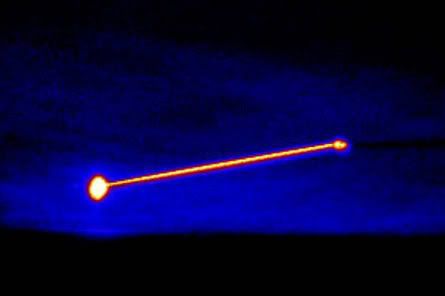
Una semana antes de la intercepción, el ALTB, derribó un Terrier Black Brant, un sólido cohete de 2 etapas que supone un blanco más pequeño y rápido al rayo y sistema de control suministrado por Lockheed Martin.
Sin embargo, sacar el ALTB del entorno de la investigación, no está aún claro. A pesar de haber superado un hito histórico para los sistemas de armas de energía dirigida, la intercepción se realizó en un entorno de pruebas absolutamente esteril. (Nota del traductor: entiéndase como condiciones perfectas)
Más aún, la Agencia de defensa de Misiles clasificó la información del alcance de la prueba y ocultó el tiempo necesario para destruir el objetivo, quedando poco claro la real efectividad de la tecnología Coil.
Suscribirse a:
Entradas (Atom)