domingo, 17 de abril de 2011

Boeing to Promote Innovative Solutions at Army Aviation Exposition

The Boeing Company [NYSE: BA] will showcase a wide array of aviation, training, support and technology solutions at the 2011 Army Aviation Association of America (AAAA) Annual Professional Forum and Exposition. This year’s event takes place April 17-20 in Nashville.
Boeing Defense, Space & Security aviation platforms including the AH-64D Apache, CH-47F Chinook, A160T Hummingbird, and AH-6i Light Attack/Reconnaissance helicopter and will be highlighted at the show. With a focus on technology, innovation and solutions, the Boeing exhibit at Booth #510 also will feature V-22 Osprey and ScanEagle models, tactical intelligence, surveillance and reconnaissance solutions, and integrated training and logistics solutions.
"Boeing is continuing to make the investments needed to ensure we meet our customers’ expectations, and that military men and women have the tools required to succeed on the battlefield,” said James Moran, Boeing vice president of Army Systems. “It’s an honor to support Army Aviation with Boeing products and services, and to support soldiers with the solutions needed to meet current and emerging mission needs.”

Media can access Boeing’s online press kit at www.boeing.com/bds/mediakit/2011/aaaa for program backgrounders, executive biographies, a briefing schedule and a link to high-resolution photos.
Note: All briefing times are local to Nashville (Central time).
MONDAY, April 18
1100-1130: AH-6 Light Attack/Reconnaissance Helicopter -- AH-6 Static Display, Boeing Exhibit Booth 510
David Koopersmith, Boeing vice president of Attack Helicopter Programs, and Mike Burke, Boeing director of Attack Helicopter Business Development, brief the media on the AH-6 rotorcraft program, including the vehicle’s demonstration successes and the status of platform testing.
1130-1200: A160T Hummingbird -- A160T Hummingbird Static Display, Boeing Exhibit Booth 510
Mansik Johng, Boeing manager of Advanced Development for the A160T Hummingbird, provides an update on the unmanned aerial system's status as testing and production of nine aircraft continues at the Boeing facility in Mesa, Ariz.
1415-1515: AH-64D Apache -- AH-64D Static Display, U.S. Army Apache Project Manager, Exhibit Floor
David Koopersmith, Boeing vice president of Attack Helicopter Programs, is joined by U.S. Army Apache Project Manager Col. Shane Openshaw to discuss the AH-64D Apache Block III helicopter as it progresses toward an anticipated first production delivery later this year.
1530-1630: Longbow Crew Trainer (LCT) Demonstration -- U.S. Army LCT Display, Exhibit Floor 
Reporters have the opportunity to participate in a demonstration flight from the viewpoint of the LCT pilot and co-pilot seats, including engagements using the Longbow’s missiles, rockets and 30mm gun. Army personnel discuss the benefits and applications of training simulation technologies.
TUESDAY, April 19
1130-1230: CH-47F Chinook Cockpit Simulator Demonstration -- CH-47F Simulator, U.S. Army CH-47F, Exhibit Static Display Area
Mark Ballew, Boeing director of Business Development for Chinook Programs, is joined by Col. Robert Marion, U.S. Army Cargo Helicopter program manager, to provide a demonstration of the CH-47F cockpit and Digital Automatic Flight Control System.
1300-1400: V-22 Osprey Brief -- Boeing Press Room, Canal D
Bill Sunick, Boeing Business Development manager for the V-22 Osprey program, talks with media about the program’s status and successes, focusing on the capabilities of the Osprey deployed today.


jueves, 14 de abril de 2011

Boeing Expands Landing Gear Solutions Capability and Offerings

MIAMI, April 13, 2011 /PRNewswire/ -- Boeing (NYSE: BA) has expanded its Landing Gear Overhaul and Exchange Program to cover the 777-200LR (Longer Range), 777 Freighter and 777-300ER (Extended Range) airplanes to provide more customers with greater service for landing gear support.
Boeing's Material Services currently provides landing gear overhaul and exchange solutions to more than 75 customers on the MD-11, 717, Next-Generation 737, Boeing Business Jet, 747-400ER, 757-300, 767-300ER and the 777-200ER airframes.
"Landing gear exchange is a proven service that helps airlines operate more efficiently by providing service-ready landing gear when they need them," said John Borst, director of Material Services Landing Gear Programs. "Boeing's landing gear team works with our partners across the globe to develop solutions for our customers."
Using the global network of Boeing repair service centers, airline customers will receive certified landing gear support anywhere around the world from Boeing. It provides quick, reliable access to landing gear repair, exchanges and overhauls, which greatly reduces maintenance time and quickly returns their airplanes to revenue service.
Boeing provides expendable, rotable, repairable and consumable parts to customers around the globe. Products and services include Boeing-proprietary, industry-standard and vendor-proprietary parts; leasing and exchange options; and repair and overhaul services.


Boeing South Carolina Achieves Zero Waste to Landfill Status

NORTH CHARLESTON, S.C., April 13, 2011 – Boeing [NYSE: BA] announced today that its Boeing South Carolina 787 production, final assembly and delivery site has become the company’s first major commercial airplane production facility to achieve zero waste to landfill status. The North Charleston, S.C., site is the fourth within Boeing to reach this milestone achievement.
Zero waste to landfill means that none of the waste materials and by-products generated at the site reaches landfill. Waste material is recycled or reused or otherwise repurposed, reducing the site’s overall environmental footprint.
"We are committed to being an environmentally responsible corporate citizen, both here in the South Carolina Lowcountry and in every community where Boeing operates," said Tom Deem, Boeing South Carolina Environment, Health and Safety director. “That commitment reflects the priorities of our fellow South Carolinians who make their homes here and want to preserve and protect this unique ecosystem.”
Ongoing employee awareness activities, innovative solutions to numerous waste stream challenges, and a partnership with Sonoco Recycling, a South Carolina-based packaging and materials recovery company, are some of the Boeing South Carolina initiative’s key components.
Components of the site’s zero waste to landfill plan include a comprehensive recycling program with point-of-use containers as well as recycling centers located across the site. Food scraps also are collected in cafeterias and break rooms for composting. Larger packaging waste materials that can’t be reused are removed from the site by Sonoco for recycling or repurposing.
"'Reduce, reuse, and recycle' is the foundation for our zero waste to landfill plan," explained Tony Soto, site Environment, Health and Safety manager and Zero Waste to Landfill project lead. "We capitalized on the unique opportunity to establish the program early at the site to support Boeing enterprise targets for solid waste recycling and demonstrate our commitment to environmental stewardship. We are reducing the amount of material we bring onsite by utilizing reusable containers whenever possible, which are returned to suppliers."
Zero waste to landfill is just one of many ways that Boeing South Carolina is demonstrating its environmental stewardship. When the land was cleared to prepare for the construction of the new 787 Final Assembly building, approximately 2,100 tons of timber was taken to local sawmills and made into lumber used in construction. The remaining wood stock was fed into chippers and used as a renewable power source for industrial boilers. Boeing South Carolina received a Spotlight Award from the Carolina Recycling Association on March 31 for these conservation efforts. 
The site is aligned to meet or exceed the Enterprise standard for Leadership in Energy and Environmental Design certification goal of Silver, as established by the U.S. Green Energy Council, for all new buildings currently under construction. The company has sponsored and participated in local Earth Day events and activities and continues to encourage participation by all Boeing South Carolina teammates in recycling efforts at work and home.
"This is an exciting time for Boeing South Carolina," said Jack Jones, site vice president and general manager. “We’re continuing to produce 787 mid and aft body sections and we’re preparing to induct the first airplane into Final Assembly here in South Carolina this summer. At the same time, our team also remains focused on our responsibilities to the environment and our community.”

Airbus sponsors electric concept aircraft “eGenius”. Technology demonstrator at international Aero-Expo in Friedrichshafen, Germany


On its way to develop alternative energy-sources for greener aviation, Airbus is also supporting basic research activities for electric aircraft concepts. The “eGenius” technology demonstrator, an electrical propelled two-seater aircraft designed by the Institute of Aircraft Design at the University of Stuttgart, Germany, is presented for the first time at the international Aero-Expo in Friedrichshafen, Germany.
Airbus, as main sponsor of the project, is examining the long-term potential of electricity as alternative major onboard energy source. The data collected from the practical operation with the “eGenius” aircraft will be analysed by Airbus’ Future Projects teams to further develop the technology and better understand its opportunities.
“It is our European Aviation Vision 2050 to reduce CO2-emissions by 75%, NOx by 90% and noise by 65% compared to levels in 2000“, explains Christopher Emerson, Airbus Senior Vice President Product Strategy and Market Forecast. “Airbus is therefore carefully studying all technologies available today for future alternative aviation energy-sources. By sponsoring experimental projects like the “eGenius”, we are gathering valuable experience and data for our further analyses and research activities in this area.”
Airbus is supporting various research and technology projects in close cooperation with universities and research institutes. Besides the monitoring of the electric propulsion technology, Airbus is also developing fuel cell technology as alternative energy source, enabling an emission-free aircraft operation on ground. In addition, Airbus is strongly engaging in implementing and testing bio-fuel technology and actively supports the installation of local bio-fuel value-chains around the world.
Facts&Figures for “eGenius”aircraft:
  • Wing span 16.86m
  • MTOW 850 kg
  • Wide fuselage for two pilots sitting side by side
  • Range 400 km
  • Cruise speed up to 235 km/h
  • Engine power 60kW
  • Equivalent energy consumption per 100km and passenger: 0.6 l fuel 


Press Release

miércoles, 13 de abril de 2011

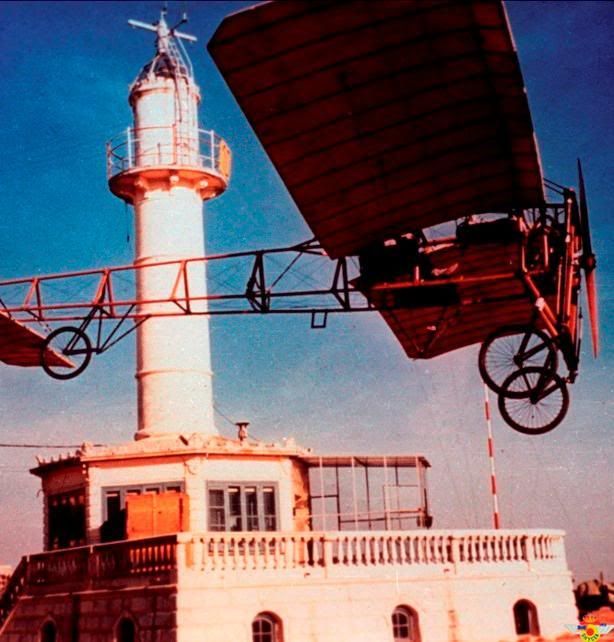
Episodio 15: Especial centenario del Aeródromo de Cuatro Vientos y Aviación Española


Traemos episodio muy especial. Un episodio para celebrar el centenario de la aviación española, grabado en el lugar donde todo comenzó: el Aeródromo de Cuatrovientos. Y para hablar del tema, unos invitados de lujo: El Sr. Jose Luís Olías, presidente del RACE, Sr. Enrique Caballero, investigador de técnica aeronáutica y el Sr Cayuela, aerotrastornado cuya pasión es el aeródromo de Cuatrovientos.

Podéis escucharlo on-line o descargarlo, o conseguirlo a través de i-tunes...

Dirección del episodio: Jose Manuel Gil
Redacción: Jose Manuel Gil, Jose Miguel Morales
Locución: Jose Miguel Morales, Jose Manuel Gil, Elena Ruiz.
Música y edición: Javier F. Lago
Layout & Diseño: Anna Esquius & Javier F. Lago
Medios, hosting y soporte: Satori Produccions SL
Producido por Satori Produccions SL (info@satori-produccions.com)


Programa de la Semana de actos conmemorativos en el Real Aero-Club de España: 25 de abril a 1 de mayo de 2011
Este programa es provisional, y puede estar sujeto a variaciones.  Organizan la Tienda Bucker Book, Real Aeroclub de España y Revista Fly News

martes, 12 de abril de 2011

First Airbus Military A330 MRTT for UAE Air Force makes maiden flight


The first Airbus Military A330 MRTT for the United Arab Emirates Air Force has successfully completed its maiden flight following conversion of the aircraft in Madrid.


The crew reported that the aircraft, its systems and two Rolls-Royce Trent 700 engines performed entirely satisfactorily during the 2hr 55min flight on 9th April.

As it features some different avionics, and is the first “receiver” to be powered by the Rolls-Royce Trent engine, the UAE A330 MRTT now enters the certification and qualificationphase for these new elements.

The first of three ordered by the UAE AF, it will transfer to Abu Dhabi around the end of theyear for the final phase of flight-testing leading to delivery in the second quarter of 2012.

Prior to this flight, six A330 MRTTs had already flown. Those include three for the RoyalAustralian Air Force (RAAF), two for the UK Royal Air Force, and one for the Royal Saudi Air Force. Two of the aircraft are already technically complete and ready for delivery to the RAAF, pending finalisation of contractual discussion.

The picture shows the first A330 MRTT for the UAE AF landing at Airbus Military´s Getafe base.

viernes, 8 de abril de 2011

Tecnam presenta la nueva versión del afamado P92


·        El nuevo Tecnam P92 EagletG5 - LY se presentará oficialmente en la Feria Aero 2011 de Friedrischafen


Madrid, 8 de Abril de 2011.- Tecnam anuncia hoy el lanzamiento del P92 Eaglet LY, la quinta generación del exitoso modelo P92 Eaglet.

Este nuevo modelo será descubierto al público el próximo 13 de abril en la feria Aero 2011 en Friedrischshafen. El Tecnam P92 Eaglet LY incorpora una nueva planta motriz, el Lycoming YO-233-B2A, así como importantes mejoras en el fuselaje y otros sistemas y estará disponible tanto en la versión CS/VLA para Europa, como LSA para Estados Unidos.

Metalizado, con dos plazas, y ala alta arriostrada es producido por Tecnam en sus instalaciones de Capua, Italia. El Tecnam P92 Eaglet LY está equipado con un motor Lycoming YO-233-B2A, que permite que el Eaglet LY ascienda a una tasa de 1.200 pies/min y alcance un crucero al 75% de potencia de 219 Km/h.

" Con su espacioso interior, sus generosos 20 kg de equipaje junto con una magnífica visibilidad, los Tecnam P92 Eaglets son aviones para disfrutar de vuelos de travesía, y han demostrado ser también robustos entrenadores" dijo Paolo Pascale, Director General de Tecnam. Ésta quinta generación de P92 Eaglet continua nuestro objetivo de desarrollar aviones con estilo, económicos, y de fácil manejo y mantenimiento. Para el equipo de Tecnam, diseñar y fabricar aviones no es sólo un trabajo, es una extensión de nuestra pasión por el vuelo'

El Lycoming YO-233- B2A, con 2400 hrs de TBO, ofrece 115 hp a 2800 rpm. Junto con una hélice de paso fijo, cuya geometría y aerodinámica fue minuciosamente seleccionada, que permiten al Eaglet LY alcanzar prestaciones de primera clase.

El motor está bien aislado de vibraciones a través de anclajes dyna-focal. Su fácil y compacta instalación es muy accesible. El consumo de combustible en régimen de crucero económico es de 5,3 gal/h (20 litros/hora) lo que permite que la autonomía sea comparable con niveles de automoción. De la misma manera, al tener más potencia disponible las prestaciones de ascenso y techo de servicio mejoran sustancialmente.

Un arranque y alternador tradicional, junto con el nuevo sistema electrónico de encendido completan la eficiencia y versatilidad de este nuevo motor Lycoming YO-233-B2A.

La alta eficiencia del ala está basada en el bien conocido perfil NACA63A, mientras que los slot flaps amplían la superficie alar permitiendo velocidades de pérdida realmente bajas con unas excelentes prestaciones para el despegue y aterrizaje.

El estabilizador horizontal usado por Tecnam y conocido en todos sus modelos, permite un excelente control y estabilidad longitudinal en todo momento.

El tamaño del panel de instrumentos ha sido ampliado debido a que la cabina es más ancha. A su vez, su diseño modular permite acomodar la más completa  instrumentación bien sea analógica ó digital.

El tren de aterrizaje principal, carenados y ruedas son los mismos que en el resto de modelos de Tecnam con tren de aterrizaje fijo.
La rueda de morro es libre y consiste en una pata de acero tubular conectada a la parte baja de la bancada del motor, utilizando un amortiguador oleo-neumático el cuál ha sido diseñado para operar en pistas y superficies no preparadas, así como para la intensa actividad de instrucción. Todo el tren de aterrizaje ha sido carenado con la finalidad de disminuir la resistencia. El control direccional en el suelo se realiza mediante frenada diferencial.

El fuselage del P92 Eaglet ha sido modificado en su sección frontal para permitir un mayor ancho de cabina, puertas más anchas para facilitar el acceso al interior. También el compartimento de equipaje ha sido ensanchado y se ha añadido una puerta exterior de acceso al mismo.


Sobre Tecnam

Tecnam Aviation fue fundada en 1986 por los hermanos Pascale. La empresa cuenta con dos plantas de fabricación en Italia. Una de 11.000 metros cuadrados cerca del Aeropuerto Internacional de Nápoles, en Capodichino, y otra de 12.000 metros cuadrados en Capua, en el Aeropuerto Oreste Salomone.
La red de distribución de aviones Tecnam incluye distribuidores en los países extranjeros, Dedalus Aircraft (www.dedalusaircraft.es) es la compañía distribuidora en España.
Los aviones Tecnam que se fabrican actualmente ofrecen una diversa gama de opciones ajustadas para cada cliente. Tienen configuración de asientos para dos o cuatro ocupantes, y utilizan en la mayoría de los casos el motor Rotax 912S de 100 cv. Además es un avión muy versátil que permite ser una herramienta excepcional para la enseñanza, ideales como avión escuela, tal y como demuestra la demanda de modelos como el P92 o el P2002.


jueves, 7 de abril de 2011

A400M contract amendment finalised with customer nations

The contract amendment was signed today in Seville by Patrick Bellouard, Director of OCCAR – Executive Agency, and Airbus Military CEO Domingo Ureña, in the presence of Spanish Minister of Defence Carme Chacón. National armament directors and other representatives from customer nations also attended the ceremony.

The Contract Amendment now implements the changes which were agreed in principle by the Participating Nations with EADS and Airbus Military in the Frame Agreement signed on 5th March 2010.

"This is a major milestone, and EADS is particularly proud to have the support of all governments involved in this cooperation programme that represents a strategic capacity for Europe and its defence, and for the new generation of military transport worldwide. The A400M is a fantastic new aircraft already flying with outstanding and unrivalled capabilities", said EADS CEO Louis Gallois.

"From an industrial point of view, the programme is on track. This enabled us to agree, with full confidence on the industrial go-ahead of the programme over a month ago," said Domingo Ureña, Airbus Military CEO. "We are also very satisfied with the progress of the Flight Test programme which confirms day by day the soundness of the aircraft. Also, all the pilots of the Air Forces who have already tried and flown the aircraft, expressed great satisfaction about its agility and capabilities. We are sure that, once it gets better known, many more Air Forces around the world will be keen to have it in their fleets".

With four aircraft flying, the A400M has achieved over 1,400 test flight hours and close to 450 flights. The fifth aircraft is complete and has started the final control phase prior to a first flight in early Fall. Civil Certification is to be achieved before year end, and first delivery to first operator – the French Air Force – by the turn of the year 2012 / early 2013. Today Airbus Military holds 174 firm orders from eight nations, the seven launch nations (Belgium, France, Germany, Luxemburg, Spain, Turkey and the UK) for 170,plus four for Malaysia.

PR

F-35C CF-1 Catapult Hookup


PATUXENT RIVER, Md., April 6th, 2011 -- Navy F-35 flight test aircraft CF-1 approaches the TC-7 catapult at Naval Air Station Patuxent River March 22. With U.S. Marine Corps test pilot Lt. Col. Matt "Opie" Taylor at the controls, CF-1 completed functional checks and performed the first test hookup of the F-35C to the catapult. The test team also investigated an issue discovered during a preliminary fit check with the launch bar where it did not lower far enough to engage flight deck hardware for the catapult hook up. That test resulted in an improvement made to the launch bar so it will have a greater range of motion. The overall ship compatibility test phase, including catapult launches, is scheduled to begin this year. Shipboard testing of the F-35C aboard a CVN-68 class aircraft carrier is scheduled to take place in 2013. The F-35C Navy variant and F-35B Marine Corps variant are undergoing test and evaluation at NAS Patuxent River in preparation for eventual delivery to the fleet.

PR

miércoles, 6 de abril de 2011

Sikorsky Selects Aurora for S-97 RAIDER


Manassas, VA, April 4, 2011 – Aurora Flight Sciences announced that it has been selected by Sikorsky Aircraft Corporation to design and build prototype airframes as part of the S-97 RAIDER™ program.

Aurora's design and manufacturing role will take place over the next several years. Applying Sikorsky structural design methodologies, Aurora engineers will design the airframe to meet challenging weight, strength, and stiffness criteria. The airframe will be manufactured and assembled at Aurora's Columbus, Mississippi facility.

"We are pleased to join Sikorsky's team to develop the S-97 RAIDER prototype," said John Langford, Aurora's President and CEO. "Our demonstrated success in rapid prototyping and our experience in transitioning prototype programs into production were key factors in Sikorsky's decision to select Aurora for this high priority development program."

The S-97 RAIDER program is based on Sikorsky Aircraft's development of the next-generation X2 Technology™ rotary wing demonstrator aircraft, which features twin coaxial counter-rotating main rotors and a pusher propeller. The National Aeronautic Association recently selected the Sikorsky Aircraft's X2 Demonstrator Team as the recipient of the 2010 Collier Trophy. In addition to flying at nearly twice the speed of a conventional helicopter, the S-97 RAIDER prototype aircraft will incorporate other key performance parameters critical to combat operations — increased maneuverability, greater endurance, reduced acoustic noise signature, and the ability to operate at high altitudes.

About Aurora Flight Sciences
Aurora Flight Sciences designs and builds robotic aircraft and other advanced aerospace vehicles for scientific and military applications. Aurora is headquartered in Manassas, VA and operates production plants in Bridgeport, WV and Columbus, MS and a Research and Development Center in Cambridge, MA. To view recent press releases and more about Aurora please visit our website at www.aurora.aero.

"S-97 RAIDER" is a trademark of Sikorsky Aircraft Corporation.


PR

Lockheed Martin F-35 Flight Test Program Shows Progress In First Quarter

FORT WORTH, Texas, April 4th, 2011 -- Lockheed Martin [NYSE: LMT] F-35 Lightning II test jets made considerable flight test progress during the first quarter of 2011, conducting 199 test flights versus a plan of 142 flights. Additionally, the F-35B short takeoff/vertical landing (STOVL) variant logged six times more vertical landings in the first quarter than in all of 2010. The test program remained ahead of plan despite the grounding of various test fleet aircraft for 4-15 days during the period as officials investigated the cause of a dual generator/starter failure during a flight on March 9.

The following totals and highlights provide a snapshot of flight test activity in the first quarter:

   * Conventional takeoff and landing (CTOL: F-35A) aircraft conducted 82 flights against the plan of 62.
   * STOVL (F-35B) aircraft conducted 101 flights against a plan of 62.
   * Carrier variant aircraft accomplished 16 flights of 18 planned.
   * Two production-model aircraft, AF-6 and AF-7, flew for the first time in preparation for delivery to the U.S. Air Force this year. AF-6 and AF-7 flew seven times in the first quarter.
   *  The STOVL variant performed 61 vertical landings (compared with 10 vertical landings in all of 2010). BF-1 performed the first touch-and-go maneuver in VL mode this quarter.
   * From the start of flight testing in December 2006 through March 31, 2011, F-35s have flown 753 times, including production-model flights.

The F-35 Lightning II is a 5th generation fighter, combining advanced stealth with fighter speed and agility, fully fused sensor information, network-enabled operations and advanced sustainment. Lockheed Martin is developing the F-35 with its principal industrial partners, Northrop Grumman and BAE Systems.

PR

Air Arabia selects Sharklets for its new A320 fleet

Airbus' new large wingtip devices to enhance performance of Air Arabia's A320s
6 April 2011 Press Release

Air Arabia (PJSC), the first and largest low-cost carrier in the Middle East and North Africa, has selected Sharklets for 28 out of 44 A320 aircraft ordered by the airline. Deliveries of these Sharklet-equipped Airbus aircraft will begin from the second quarter of 2013.

Delivery of Air Arabia's order of 44 Airbus A320s (34 placed in 2007 and 10 in 2008) has already started in the last quarter of 2010 and will make the carrier one of the region's largest A320 operators with one of the most modern single-aisle fleets.

"Air Arabia is on the path of a reasonable expansion, in-line with the company's vision to become one of the world's leading airlines in terms of eco-efficiency, profit margin, innovation, and operational excellence. This new order will further contribute to the airline's operational efficiency when we take delivery of the first Sharklet-equipped A320s in 2013," said Adel Ali, Board Member and Group CEO of Air Arabia.

"We are delighted that Air Arabia has taken the opportunity to maximise the capability and efficiency of its future A320 fleet by equipping them with our fuel-saving Sharklets," said John Leahy, Airbus Chief Operating Officer, Customers. "The popular A320 Family already has the best reliability, highest revenue-generation and the lowest operating costs of any single-aisle aircraft in its class, and with the new Sharklets, customers like Air Arabia will benefit even more," he adds.

Sharklets were launched for development in 2009. These new wingtip devices are around 2.5 metres tall and further enhance the efficiency of the popular A320 Family by replacing the aircraft's current wingtip fence. Offered as an option on new-build aircraft from the end of 2012, the devices reduce fuel burn particularly over longer sectors. As well as increasing payload-range and improving take-off performance, Sharklets result in around 3.5 percent reduced fuel burn over longer sectors, corresponding to an annual CO2 reduction of around 700 tonnes per aircraft.

Air Arabia already operates a large fleet of new and leased A320s. From its main hubs, Sharjah in the UAE, Casablanca in Morocco, Alexandria in Egypt, the carrier serves a network of more than 65 international routes across Europe, the Middle East, Asia and Africa.

The A320 Family (A318, A319, A320 and A321) is recognised as the benchmark single-aisle aircraft family. Nearly 7,000 Airbus A320 Family aircraft have been ordered and more than 4,600 delivered to more than 320 customers and operators worldwide, making it the world's best-selling commercial jetliner ever.

Dos muertos en un accidente aéreo en Medina Sidonia

Ayer por la tarde se localizaron los restos de un accidente de un autogiro ultraligero en un lugar escarpado del término municipal de Medina Sidonia (Cádiz).

El ultraligero habría perdido el control, estrellandose contra el suelo. Su identidad se desconoce, ya que no pertenece a la flota del aeródromo "AerSidonia", que opera en la zona.

Dentro de los restos se han encontrado dos cadáveres completamente calcinados, lo que dificulta las labores de identificación.

Mas información

Boeing to Feature Latest Innovations at National Space Symposium

Approach and Landing Test Vehicle, CST-100 mock-up among products on display
COLORADO SPRINGS, Colo., April 4, 2011 -- The Boeing Company [NYSE: BA] will spotlight its satellites, human spaceflight activities and network-enhanced technologies at the Space Foundation's 27th National Space Symposium. This year's event takes place April 11-14 at The Broadmoor Hotel in Colorado Springs.

"The National Space Symposium gives Boeing the opportunity to showcase our strengths in developing and delivering innovative space and satellite capabilities," said Roger Krone, president of the Network and Space Systems business unit of Boeing Defense, Space & Security.

"Our business is focused on bringing NASA, the Department of Defense and our commercial partners new, cost-effective capabilities for their spaceflight and satellite communication missions."

The Boeing exhibit, at Booth #200, will showcase the company's support for military and commercial satellite operations and the International Space Station, as well as its development of space exploration vehicles and unmanned capabilities. The centerpiece of this year's exhibit is a 3-D, interactive satellite demonstration in which users can explore Boeing's modeling and simulation capabilities in different satellite environments.
This year Boeing will debut its first outdoor display of innovative space equipment. The Approach and Landing Test Vehicle, which preceded the United States' first unmanned vehicle to return from space and land on its own, the X-37B, will be on display in front of the Boeing Exhibit Center North. In addition, a mock-up of Boeing's Crew Space Transportation (CST)-100 spacecraft and a pressurized structure of the crew module will be on display in the new Boeing Exhibit Center Showroom, located east of the Boeing Exhibit Center South.

Boeing also will participate in the symposium speaking agenda. Krone will be a panelist in the Industrial Base Mega Session on April 12 at 2:20 p.m. He will share his perspective on the economic and efficiency challenges facing space and defense industry partners and offer ideas on how to implement solutions. Also on April 12, Brewster Shaw, vice president and general manager of Boeing Space Exploration, will join other former space shuttle commanders in the Shuttle Commanders Forum at 4 p.m.

Boeing's online press kit at www.boeing.com/bds/mediakit/2011/space11/ contains program backgrounders, biographies and a link to high-resolution photos. The site will be updated throughout the show.
Note: All briefing times are local to Colorado Springs (Mountain time). Reporters interested in the news briefings are asked to confirm their attendance in advance with the contacts listed below no later than Thursday, April 7.
A toll-free number will be provided for reporters who are unable to participate in person.
WEDNESDAY, April 13 -- Space Foundation Media Center, The Broadmoor Hotel
10 a.m.: Commercial Crew Development
John Elbon, vice president and program manager of Boeing Space Exploration's Commercial Crew Programs, provides an update on Boeing's solution for a commercial crew capsule to transport people between Earth and the International Space Station and Bigelow Aerospace's space station.
11:15 a.m.: Boeing Satellites
Craig Cooning, vice president and general manager of Boeing Space and Intelligence Systems, and Jim Simpson, vice president of S&IS Business Development, discuss hosted payloads and priority satellite programs.
1:45 p.m.: Advanced Network and Space Systems
Todd Citron, director of Advanced Space and Intelligence Systems, part of Boeing Phantom Works' Advanced Network and Space Systems, discusses nanosatellite technology.


PR

Boeing Delivers 2 F-15K Slam Eagles to the Republic of Korea

DAEGU AIR BASE, Republic of Korea, April 5, 2011 -- The Boeing Company [NYSE: BA] today announced that it delivered F-15K 47 and F-15K 48 to the Republic of Korea Air Force (ROKAF) at Daegu Air Base on March 15. The two F-15K Slam Eagles departed St. Louis on March 8 and made stops in Palmdale, Calif., Hickam Air Force Base, Hawaii, and Anderson Air Force Base, Guam.

"Boeing continues to work closely with its ROKAF customers to ensure we deliver quality aircraft on schedule and on budget," said Roger Besancenez, Boeing F-15 Program vice president. "We are committed to providing the ROKAF with the most capable combat-ready multirole aircraft in the world."

Six of the new F-15K Slam Eagles are scheduled to participate in an advanced aerial combat training exercise at Nellis Air Force Base, Nev., in early 2012.

Boeing delivered the first six of 21 F-15Ks it is producing under the Next Fighter II contract in 2010. The remaining 13 aircraft will be delivered through April 2012.

The F-15K is an advanced variant of the combat-proven F-15E. Equipped with the latest technological upgrades, it is extremely capable, survivable and maintainable. The aircraft's service life is planned through 2040, with technology insertions and upgrades throughout its life cycle. Boeing completed delivery of 40 Next Fighter I fighter aircraft to the ROKAF in October 2008.

Boeing

martes, 5 de abril de 2011

Aircraft Interiors Expo 2011: Cabin flexibility throughout the Airbus Family for added customer value

Reveal of new lavatory concept freeing-up space for more seats on A320 Family cabin

5 April 2011 Press Release

Airbus once again showcases its cabin innovations at this years' Aircraft Interiors Expo in Hamburg, Germany. The leading manufacturer presents a market research mock-up of a space-saving rear lavatory and galley concept for the A320 Family for the first time.

Called Space-Flex, the concept makes more efficient use of the volume at the rear of the cabin. The result: two lavatories plus a galley can now be accommodated in this space, offering airlines the possibility to install up to three more revenue-generating seats in the cabin and/or to improve seat pitch. One of the Space-Flex lavatories provides full access for 'Persons with Reduced Mobility' (PRM) through a simple conversion process: an industry first on a single-aisle aircraft.

Another key to cabin flexibility, the A350 XWB enabling platform, is impressively demonstrated at the Airbus booth. Standard interfaces designed to accommodate a wide variety of operator needs and cabin furnishings based on modular designs combine to facilitate the customization of the cabin and allow airlines to reconfigure their cabin in service more easily than before.

The A380 display underlines the unmatched passenger appeal of the world's biggest passenger aircraft. With more than 40 aircraft in service, the A380 is getting overwhelmingly positive passenger feedback and brings operators higher load factors and increased revenues.

Airbus' SPICE galley project (ace nnovative atering quipment) has been making steady progress during 2010. After revealing the operational prototype at last years' Aircraft Interiors Expo, Airbus will present the progress of user trials performed at a full-scale test facility in Toulouse, demonstrating full cabin service for up to 200 passengers. The space-saving catering system improves crew working conditions at the same time as saving hundreds of kilograms of weight and generating space for additional revenue seats.

Airbus space-efficient concepts go beyond new products. Airbus Upgrade Services will present its range of retrofit solutions and services. Cabin experts and students or young talents can inform themselves about career opportunities at Airbus and personally talk to human resources representatives.

The Airbus stand is located in hall 7, booth number 7D20.

PR

Airbus Statement Tom Enders on AF447 debris discovery

4 April 2011

"Airbus welcomes the news of the discovery of the AF447 wreckage.

This is a relief for all those affected by this tragic event, in first place the relatives and friends of the victims.

We do hope that this discovery will lead to the retrieval and the reading of the two recorders because these data are essential for the understanding of this accident.

This discovery is very encouraging and rewards the tremendous efforts of all those who never gave up. It underlines how important air safety is to all actors of the air transport community."

Tom Enders, Airbus President and CEO


PR

SuperJet International completes first Aeroflot Flight Crew Training Course

March 31, 2011, Moscow - SuperJet International (SJI) - a joint venture between Alenia Aeronautica, a Finmeccanica Company, and Sukhoi Holding - has completed Flight Crew Training Course for Aeroflot pilots at its Training Center facility in Moscow. The “Type Rating course for Aeroflot pilots” on the SSJ100, conducted by SJI Staff Pilots had a duration of 24 days.

The courses involved three flight crews (6 pilots) in classroom sections which required the use of CBT (Computer Based Training), the FTD Type5 (Flight Training Device) based in Zhukovsky (Moscow Region) with the aim of FPTD (Flight Procedure Training Device). In-flight training has been also accomplished by the use of SSJ100 Serial Number 5. Upon training completion, Aeroflot Crews have been certified by Federal Air Transport Agency (Ministry of Transport of Russian Federation).

“I am proud and honored to be one of the first airline pilots who took to the air the new Russian aircraft - states Eugene Voronin, Chief of the Aeroflot SSJ100 pilots team – the aircraft is reasonably easy to control. I was really impressed and I greatly appreciated its cockpit. The SSJ100 fully differs from the cockpit of any other Russian aircraft. It is comfortable, spacious, with wonderful onboard field of view and a side-stick instead of control column. I am sure that our passengers will enjoy the flight on the SSJ100 as well”.

“It is a major step ahead for SuperJet International – states Mr. Carlo Logli Chief Executive Officer - This proves that SJI Training Team is ready to provide training courses on SSJ100 type to pilots, flight attendants and maintenance staff of airlines in Russia and in other countries. Specific training programs for Aeroflot pilots have been developed in order to ensure the right entry level training. The initial training activities have been performed through the support of Sukhoi test pilots and the SJI international team of top-level flight and maintenance instructors. SuperJet International is working hard in order to meet Customers needs and maximize the aircraft’s availability. I am confident that the set up of a professional and experienced Training Organization will guarantee a smooth entry into service of the SSJ100”.

SuperJet International, which is in charge of the Sukhoi Superjet 100 (SSJ100) sales in the Western markets, is also responsible for training and after-sales support all over the world. Given the international nature of the product, SuperJet International has established two facilities based in Venice and in Moscow for its training opportunities.

About SuperJet International:

SuperJet International, a joint venture between Alenia Aeronautica, a Finmeccanica Company (51%) and Sukhoi Holding (49%), is in charge of the marketing, sales, customization and delivery of the Sukhoi Superjet 100 regional jet in Europe, the Americas, Oceania, Africa and Japan. The Company is also responsible for training and worldwide after-sales support, as well as the design and development of VIP and cargo variants. A SuperJet International branch is active in Moscow, together with a sales office in Washington, DC, U.S.A.

PR

Mitsubishi Aircraft to Establish Europe Sales Office

Mitsubishi Aircraft Corporation announced the establishment of a locally incorporated, solely-owned subsidiary in Amsterdam, the Netherlands to function as its sales base for Europe. With the establishment of the Europe sales office, Mitsubishi Aircraft will accelerate its sales activities of the MRJ (Mitsubishi Regional Jet) in the European region. The new company will begin operation on May 1, 2011.

Europe is the second largest market for regional jet aircraft, following the United States. The new regional sales base allows Mitsubishi Aircraft to conduct on-the-ground sales activities to customers without any time differences. The Europe sales office will not only cover the European but also the Middle Eastern and African markets. It will strengthen relationships with potential customers and enhance the presence of the MRJ brand to secure new orders.

Mitsubishi Aircraft expects 5,000 regional jets to be in demand in the next 20 years; 30% of which will come from Europe. Amsterdam was chosen as the best suitable location to conduct the most efficient and productive sales activities in this huge market because of its central location and excellent connectivity within Europe. The main purpose of the Europe sales office is to boost sales activities, gather information, and conduct public relations. Furthermore, the office will promote the MRJ brand to the market and develop a higher brand profile.

Dr. Philip de Heer, Ambassador of the Netherlands to Japan, commented as follows: "The contacts between Japan and the Netherlands started with the ship 'de Liefde' washing ashore on the coast of Japan on April 19th, 1600. Almost 411 years later, Mitsubishi Aircraft Corporation Europe makes a smooth landing in the Netherlands. The differences between the two events are obvious, the similarity too: both are the beginning of a long relationship in which business and reliability are the key drivers. "

Hideo Egawa, President of Mitsubishi Aircraft Corporation commented as follows: "Since the opening of the business in the U.S. Sales Office in November 2008, we have worked to build stronger bonds with our customers and have concluded the definitive Purchase Agreement with Trans States Holdings for the order of 100 MRJ aircraft last December. We have many potential customers showing strong interest in the MRJ in the European region. We expect establishing this new sales office will greatly enhance our presence in the region, resulting in new orders. "


Overview of the New Company (as of April, 2011)
Company Name : Mitsubishi Aircraft Corporation Europe B.V.
Major Activities : Securing orders and sales activities, gathering information and conducting Public relations for the European, Middle Eastern, and African regional market
Business Opening Day : Currently Scheduled on May 1, 2011
Location : Amsterdam, the Netherlands
Capital : 500,000 EUR
Shareholder composition : Solely owned subsidiary of Mitsubishi Aircraft Corporation
President : Akinori Kojima
(Currently Manager in Sales and Marketing Department European region)
Number of Employees : 4 (at the time of establishment)

PR

Mitsubishi Heavy Industries, Ltd. Commences Mitsubishi Regional Jet Assembly Work

Tokyo and Nagoya, April 5, 2011 – Mitsubishi Heavy Industries, Ltd. (MHI) and Mitsubishi Aircraft Corporation have jointly announced the commencement today by MHI of assembly work on the next-generation Mitsubishi Regional Jet (MRJ). Based on an order placed by Mitsubishi Aircraft, which is developing the MRJ, MHI began riveting work on the frame structure surrounding the emergency escape hatch for crew in the cockpit roof of the aircraft. While manufacture of individual parts had already begun last autumn, today's start of assembly work indicates that the MRJ project to develop Japan's first passenger jet is progressing steadily and firmly as scheduled. The aircraft's first flight is slated for 2012.

To mark this beginning of assembly work on the MRJ, a ceremonial rivet driving celebration was held at MHI's Tobishima Plant. The ceremony was attended by Hideo Egawa, President of Mitsubishi Aircraft, and Akihiko Ishikawa, General Manager of the Commercial Airplanes Division of MHI's Aerospace Systems, as well as by others involved in the project.

The start of assembly work on the MRJ signifies that the aircraft's production mode has now progressed to a new level. Going forward MHI, in addition to producing the MRJ's major components—including the fuselage, wings and empennage—will also engage in final assembly and equipment installation on receipt of the various components currently being produced by the many project partners.

MHI and Mitsubishi Aircraft will continue to devote their utmost efforts toward making the MRJ project a success, aiming to play a significant role in the ongoing development of the global aviation industry.

About the MRJ

The Mitsubishi Regional Jet (MRJ) is a family of 70- to 90-seat next-generation regional jets which will offer both top-class operational economy and outstanding cabin comfort based on a vision of applying advanced mainline jet technology to create a new standard of next-generation regional jets.

The MRJ is under development by Mitsubishi Aircraft Corporation and will be based on cutting-edge technology cultivated by Mitsubishi Heavy Industries during its many years engaged in the development and manufacture of both military and commercial aircraft.

By featuring state-of-the-art aerodynamic design, noise analysis technologies and a game-changing engine, the MRJ will significantly cut fuel consumption, noise and emissions, consequently improving airline competitiveness and profitability. The MRJ will have a four-abreast seat configuration, large overhead bins, and feature an innovative slim seat offering heightened passenger comfort.

About Mitsubishi Heavy Industries

Mitsubishi Heavy Industries, Ltd. (MHI), headquartered in Tokyo, Japan, is one of the world's leading heavy machinery manufacturers, with consolidated sales of 2,940.8 billion yen in fiscal 2009, the year ended March 31, 2010. MHI's diverse lineup of products and services encompasses shipbuilding, power plants, chemical plants, environmental equipment, steel structures, industrial and general machinery, aircraft, space rocketry and air-conditioning systems.


PR